I brought my camera to my internship, and children knew about it on the first day. I used it to catch the images of bugs in the garden and placed it on the windowsill for easy access. In the days that followed, children would occasionally ask me to capture something with my camera—a bug on their hands, their artwork, or even to take a photo of them. I also occasionally captured moments that touched me, intuitively, though I couldn’t quite articulate why at the time.
The children asked me to take their pictures, and I showed them the images in my camera. But when it came time to print and select the photos at the end of each week, I intentionally avoided the obvious aspects of the children’s daycare lives, choosing instead those that I found interesting and that I wanted to explore further. Thus began the current weekly publication, A Question Book.
Because I avoided the children’s faces when taking photos, all the pictures only showed things related to them. Therefore, not all the photos in this question book are immediately understandable or interesting to children. I’ve noticed that some children only skimmed the first few pages and left. Later, when I find an opportunity to look through the book with a child, observing and reflecting together, they really enjoy it.
Even though the photos in this book are selected, they still cover a wide range of children’s interests and concerns. So I tried to pick out something that may be suitable for further exploration with the children. With this in mind, I chose Cactus.
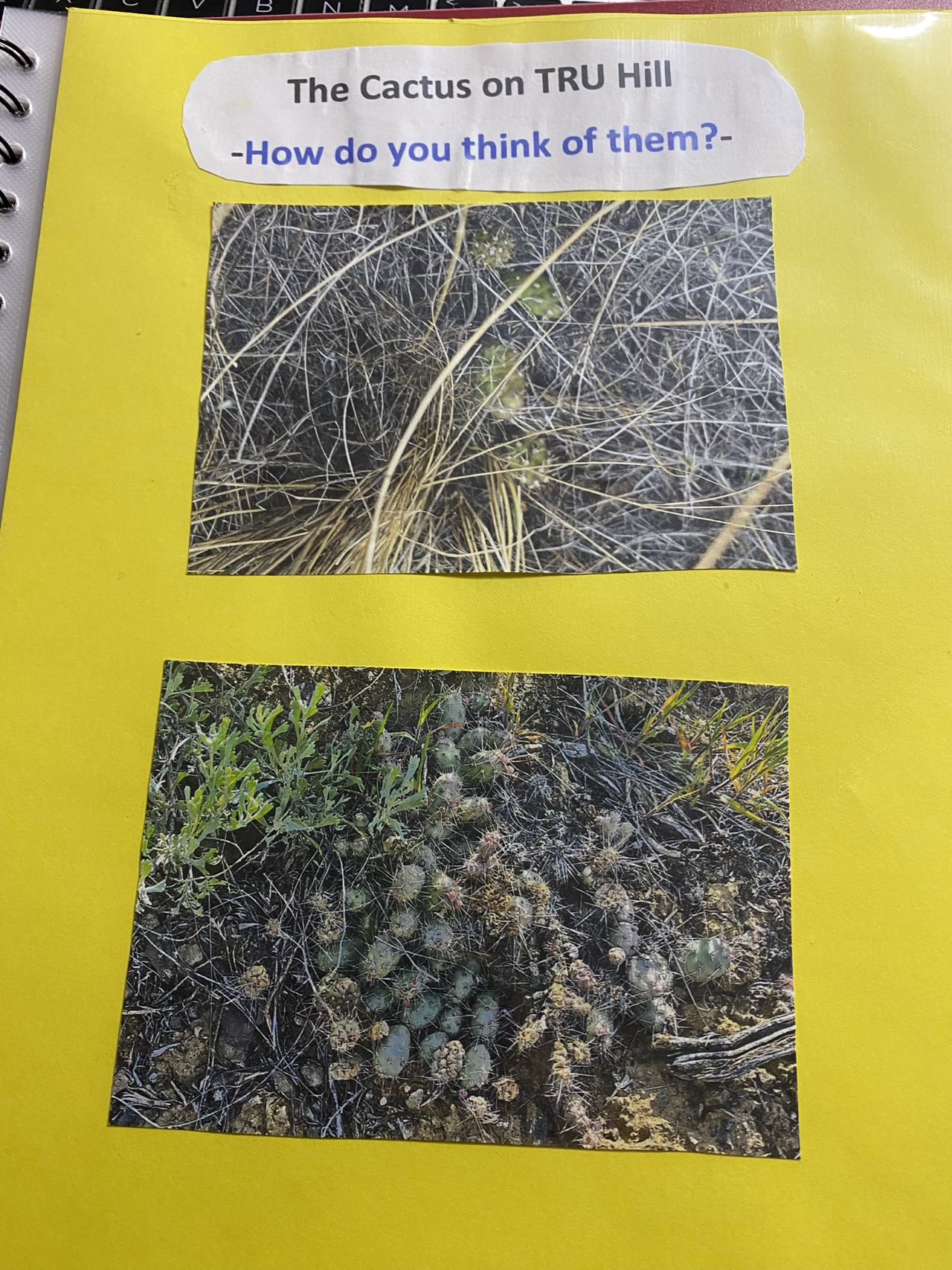
Why did I choose cactus? Actually, I’ve had a vague interest in it for a long time. During my previous internship, I observed children encountering cacti while out on TRU hill. This month, I accompanied the teachers and children on three trips to the hill, and cactus were there each time. The children’s reactions to cacti continued to vary. For example, Jalisa, a younger girl in the class, got a cactus stuck in her leggings. She tried to pull it out, and the stinging pain caused her to cry for a long time. As Jalisa cried, Everly and William, who were nearby, ran over and held the cactus between two small branches in front of Jalisa. They meant to comfort her—see! Cactus is controllable. But Jalisa, seeing the cactus, started crying and hiding. The cactus on TRU hill is like the children’s beloved pirate ship: it’s a part of the hill. It has lived there for as long as the hill itself, enduring the cycle of seasons.
I tried talking to children about Cactus, and here are some excerpts from the conversation.
Me: Penny, do you like Cactus?
Penny: I don’t like Cactus. They are so prickly.
Me: But TRU hill is their home. They live there.
Penny: No. TRU hill doesn’t want to be the home of cactus. She wants to be home of children.
Me: Jalisa, do you like to play with Cactus?
Jalisa: No. I don’t play with cactus. I play with alligator.
Me: Where is alligator?
Jalisa: Under the rocks. I like to play with alligator with Lana.
Me: I know Lana is your good friend. Would you like to visit Cactus again on TRU hill with Lana?
Jalisa: With Lana?
Me: Yes.
Jalisa: Yes, I like to see Cactus with Lana.
Me: Jason, do you know where to find Cactus?
Jason: Up to the hill.
Me: Do you like to play with Cactus?
Jason: No.
Me: Why?
Jason: Not happy. Ou-wee, ou-wee!
Me: You mean it ‘ s prickly.
Jason: Yes.
Is there any opportunity for children to get more involved with cacti? I discussed with Kim whether we could take a small group of kids back to TRU Hill to dig up a few cacti and try planting them in a small pot. We’d like to see if the cacti and children can interact more closely. Stay tuned for the next post.