First, I would like to thank professor Cory for recommending two articles in the Advanced Program Development class: “Early Childhood Curriculum” and “Early Childhood Education and Care in Canada.” These readings helped with clarity about what a daycare curriculum looks like, and they also deepened my understanding of the BC Early Learning Framework.
All my three practicums are assigned to the same classroom of Juniper. This has allowed me to observe children’s growth, as well as changes in the classroom and playground, over a longer period of time. Of course, sometimes my observations were unconscious, because at the time I did not yet have the awareness or reflective ability to understand them fully and deeply.
Well-being and Belonging & Communication & Diversity
The children at Juniper are very diverse which shows in their cultures, languages, ages, abilities, and interests. Because Juniper is close to TRU, quite a few children come from new immigrant families. At home, they may speak languages other than English, such as Spanish, Japanese, Vietnamese, or Chinese.
Compared with teachers in other daycares, Juniper teachers not only support children’s regular development and growth but also face the challenge of helping non-English-speaking children find a sense of belonging, understand teachers and peers, and build their ability to communicate. As an international student from a non-English speaking country, I deeply understand the struggles of adapting to a new language and culture. Special care and support are expected to those children with unique needs.
During my practicums, I witnessed the growth of children who were starting as not native English speakers, adapting to the new environment, and end to be “capable to live and learn well” (BC ELF, 2029). An great example is William, who were often frustrated in daycare during my first practicum, then gradually became more independent and confident in play and communication in my second practicum. Part of the reasons for William’s growth might be that Juniper teachers changed the routines for non nappers, so William could spend a lot of time freely playing in the yard. When I returned to Juniper for my third practicum, William is strong both physically and emotionally, even able to communicate with skills in conflict with others.
I have been observing a Spanish-speaking child in all my practicums. Until now, he still mainly speaks Spanish at daycare. Yet he often smiles, plays independently with ease, and happily interacts with teachers and peers in Spanish. He clearly has a strong sense of belonging at Juniper.
I have also encountered two Japanese-speaking sisters in Juniper. During my first two practicums, the older sister, Ray, was at Juniper. In my third practicum, Ray had graduated to kindergarten, and her younger sister, Lana, joined the class. It is no doubt that both girls are growing up in both English and Japanese nursing environment, so they don’t have language barriers and Japanese is one of their additional abilities.
One day, while Lana was on the swing, I was standing beside her, and we have an interesting conversation about language:
Lana: “Can you speak Japanese?”
Me: “No. I can only speak a little.”
Lana: “I speak Japanese at home.”
Me: “Can you teach me Japanese? How do you say hello in Japanese?”
Lana: “Kou ni Ji wa!”
Me: “How do you say I love you in Japanese?”
Lana: “I don’t know.”
Eva, who was also on the swing, joined in: “I can speak Japanese too.”
Me: “Wow, then you can talk to Lana in Japanese.”
Eva replied: “I only speak Japanese to myself.”
When I asked Eva how to say “I love you” in Japanese, she responded in a funny voice: “I love you!” with a rising intonation. This is often how children play with language—using a strange tone in their first language to pretend they are speaking a foreign one. We all laughed together, including Eva herself.
Others, Materials and the World
The Juniper classroom includes almost all 11 interest areas as advocated by the Creative Curriculum: blocks, dramatic play, toys and games, art, library, discovery, sand and water, music and movement, cooking, computers, and outdoors. Juniper teachers even created more areas, like the risk play area in the backyard.
When I returned to Juniper in September, as late summer time, children have still been playing with water. As I was told, this water play project has been there for the whole summer for children to explore any possibilities with water. The water table is set up either inside the sand box or directly on the ground. Children play with water in multiple ways, some of which are as follows:
Mixing sand with water. Children experimented with different containers and levels of wetness, which inspired many cooking games and conversations. Once, they decided to host a birthday party in the sandbox and I was invited to their party. While they were busy “cooking”, I prepared a gift—a small paper box holding three white stones (white tones are treasures for children to collect recently in the yard) and one marble. They loved it and treated it carefully: the three stones were placed into Melissa’s Treasure Jar (Melissa is my practicum partner who provides a jar for rock collections and takes notes), and the marble was handed to the teacher. I think this is a Juniper rule—marbles belong to Daycare.
Experimenting with water and other materials. I often saw children digging channels, building dams, and watching how water broke through. In addition to sandbox tools, nearby stones and wooden blocks became favorite materials to play with water.
Engaging with plants and water. One morning, teacher Mary brought fresh flowers and herbs from her backyard to the children. They washed them, decorated the table with them, played games with them, and even tasted them. They were fully absorbed in the experience. I couldn’t resist and tried one of the herbs myself. My tongue still remembers the strong grassy taste—it was a unique experience.
The water tap was close by and never locked. But I hardly ever saw children sneaking water, because whenever they needed water, they could ask teachers, who usually supported them. In another daycare I visited, teachers almost guarded the tap as if protecting it from theft, believing water play was too dangerous.
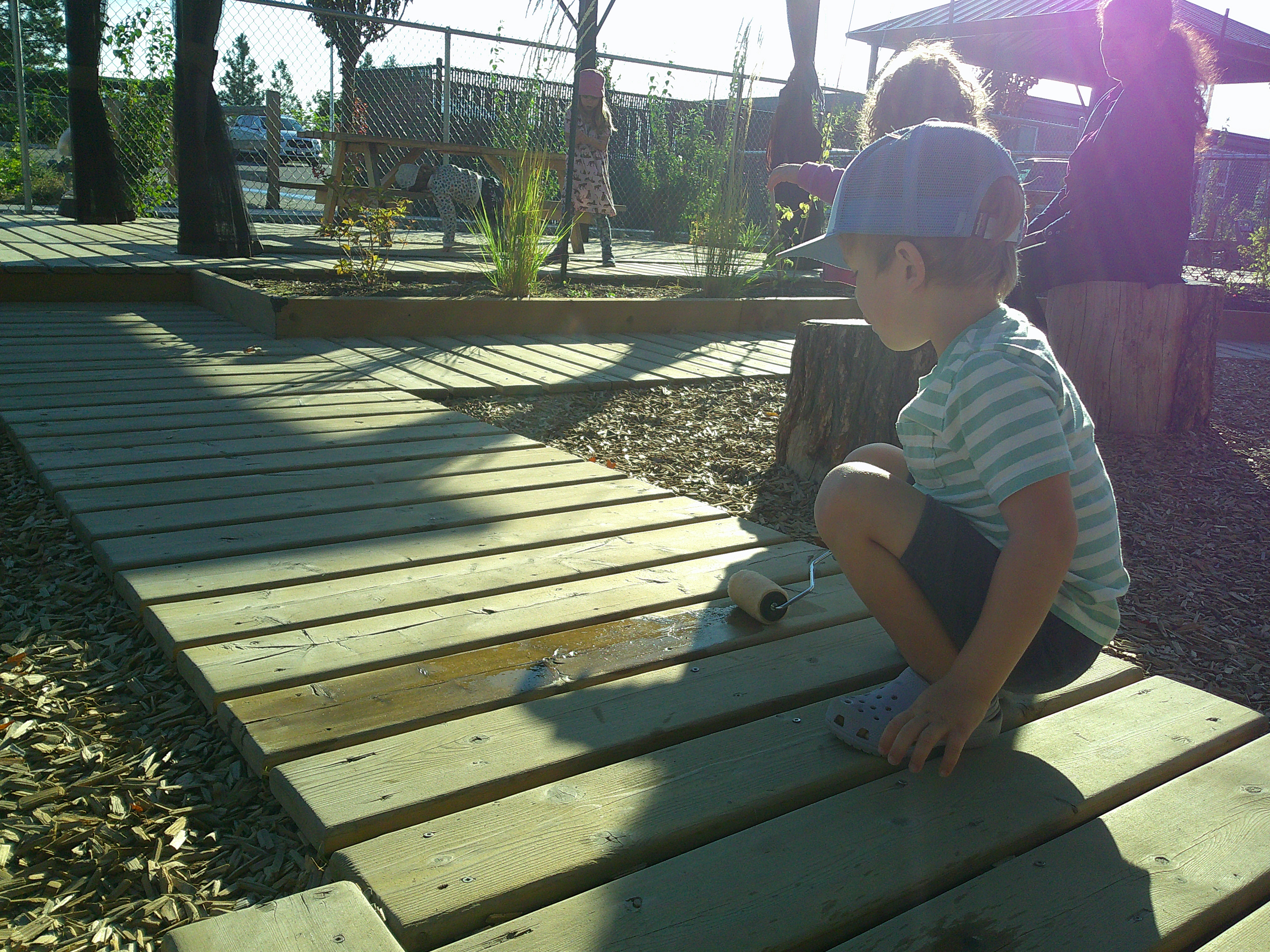
At Juniper, children not only explore water in the sandbox but also paint freely around the yard, using rollers and buckets of water. Just like the real painters, they paint the wooden path, the walls, the tables, the chairs, and even shoes. Water is the paint, and everything became a canvas.
One time, F carefully painted the wooden floor of the gazebo. Tired, he sat down, and I joined him. He invited me to paint too. I asked: “Can you paint the first letter of my name?” (F often interacts with me but never remembers my name.) He asked me what my first letter was, and I showed him. He carefully painted the letter Y with water. Then he asked me to write his name, and I did. We both enjoyed the joy of this new discovery together.
How to Engage in a Living Inquiry?
In our practicum seminar, the teacher asked us: What do you want to bring to the children? In the Advanced Program Development class, we also discussed in groups: Great ideas to explore with children.
I want to learn more about the children. At Juniper, children are well guided in exploring and respecting boundaries. Now, I would like to observe further how they interact with others, with materials, and with the land, rather than with teachers and peers, and how they learn from each other. From this, I hope to find the focus of my own inquiry.
The BC Early Learning Framework describes how an inquiry may “emerge for educators while they are paying attention to the theories children build, or when they are working with their own questions, or a combination of both” (BC ELF, 2009, p.103). This inspires me to stay attentive and discover the inquiry that will guide my future learning and teaching.